Jul 26, 2026 · 8 min read
4th Circuit: Border Agents Can Scroll Your Phone
In United States v. Belmonte Cardozo, decided July 13, 2026, a unanimous Fourth Circuit panel held that a customs officer scrolling your phone by hand is a "routine" border search needing no warrant and no suspicion. Forensic extraction tools still require suspicion. Everything an officer can reach with a thumb does not.
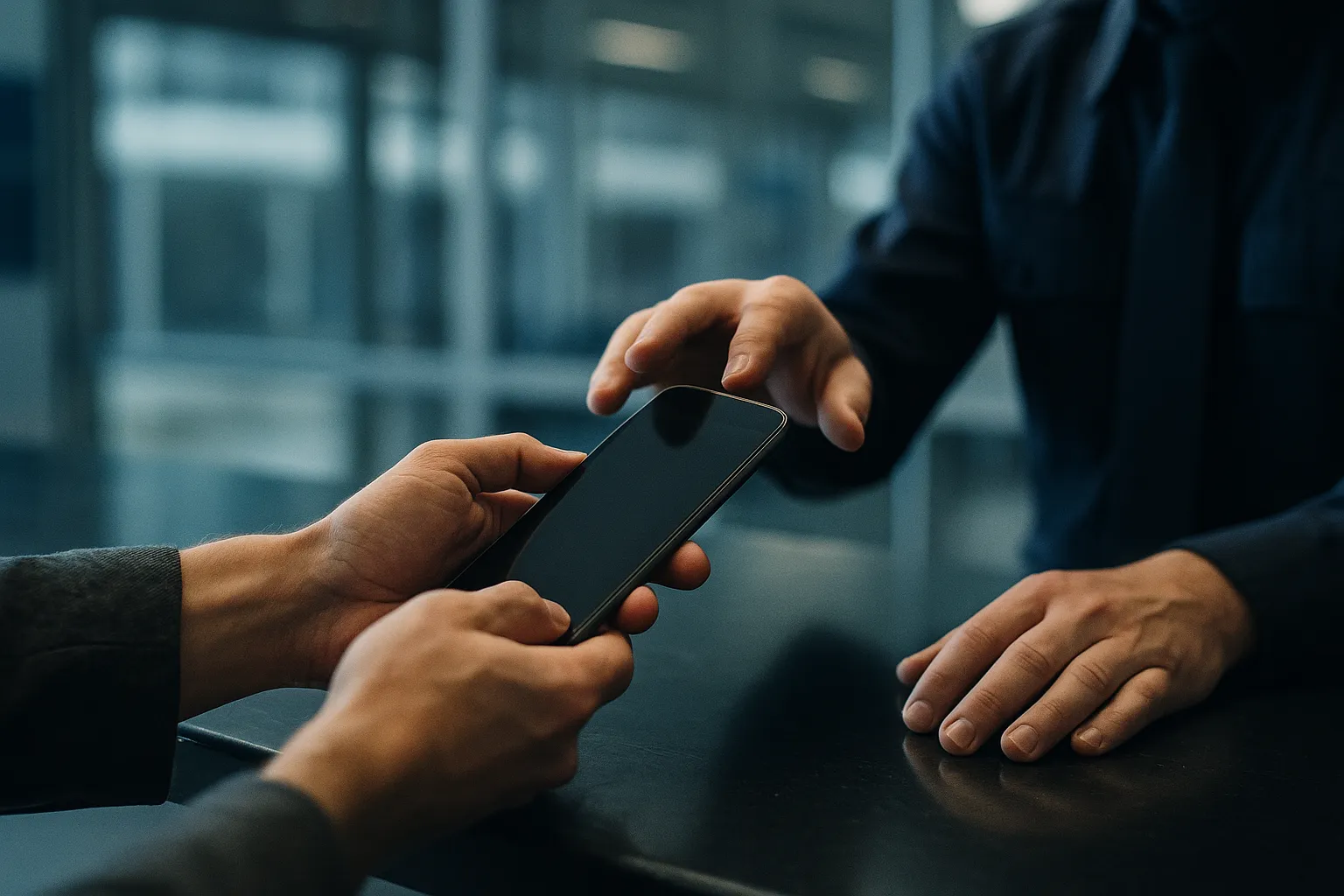
Jose Alejandro Belmonte Cardozo landed at Washington Dulles on May 8, 2024, off a flight from Bolivia. A CBP port intelligence officer named Sara Oliphant was waiting. She asked him to unlock his two iPhones, he did, and she opened the photo app and toggled to the hidden gallery. Roughly two minutes passed before she found sexually explicit images of children. He was arrested that day and later sentenced to 18 years.
Nobody disputes what she found. The fight on appeal was whether she needed any reason at all to look. The answer, from Judge A. Marvin Quattlebaum joined by Chief Judge Albert Diaz and Judge G. Steven Agee, was no. Two minutes of a stranger reading your phone is now legally the same event as a customs officer unzipping your suitcase.
Key Takeaways
- The Fourth Circuit held on July 13, 2026, in United States v. Belmonte Cardozo, No. 25-4239, that manual cell phone searches at the border need neither a warrant nor individualized suspicion.
- Officer Sara Oliphant found the evidence about two minutes after taking the phones at Dulles, and the panel treated that brevity as proof the search was less invasive than a forensic one.
- Judge Quattlebaum gave four grounds: a person rather than a machine does the looking, the search ends when the officer's patience gives out, it reaches only data a user can open, and it leaves notes rather than a permanent copy.
- CBP ran 55,318 device searches in fiscal year 2025, of which 50,922 were basic manual searches, so this holding covers roughly 92 percent of what the agency actually does at ports of entry.
- The First, Fifth, Seventh, Ninth, and Eleventh Circuits already agreed, leaving no split for the Supreme Court to resolve, as the Electronic Frontier Foundation notes.
What Did the Fourth Circuit Actually Hold?
The court held that a manual phone search at the border is routine, and routine border searches require no individualized suspicion. The opinion says so on page one: "we join all our sister circuits that have addressed this issue in holding that manual searches of cell phones at the border are routine."
That question had been open since 2018. In United States v. Kolsuz, 890 F.3d 133, the court held forensic searches are nonroutine and demand "some measure of individualized suspicion," but noted, as the new opinion recounts, that it had "no occasion" to decide the manual question. Aigbekaen, 943 F.3d 713 (4th Cir. 2019), added that the suspected offense must bear some nexus to the border exception's own purposes. The Knight First Amendment Institute, the Reporters Committee for Freedom of the Press, the ACLU, EFF, and the National Association of Criminal Defense Lawyers all filed as amici for the appellant, and lost unanimously. No dissent, no concurrence.
How Is a Manual Search Different From a Forensic One?
The court gave four reasons, worth their strongest statement before the critique. First, a person does the looking rather than a machine. Second, breadth: "A manual search ends when the officer's time, patience and attention give out. A forensic search is comprehensive." Third, reach: a manual search sees only what a user can access, while a forensic tool recovers deleted files, cached fragments, location histories, and system logs. Fourth, persistence: manual searches leave "an officer's fading memory or imperfect notes," while forensic ones produce a searchable duplicate. As the opinion frames it, "A forensic search does not end at the border crossing; it begins there."
The anchoring comparison was concrete. Oliphant's search took two minutes. The forensic search in Kolsuz ran a month and produced an 896 page report of contacts, emails, calendar entries, browsing history, and GPS coordinates. Framed that way they do look like different animals. The CBP directive governing device searches has drawn the same basic versus advanced line since January 2018, so the ruling gives an existing agency policy a constitutional floor rather than an administrative one.
Where Does This Leave the Circuit Split?
There isn't one, and that is the most consequential fact in the case. On manual device searches the appellate courts are unanimous: the Seventh Circuit in Mendez (2024), the Fifth in Castillo (2023), the First in Alasaad v. Mayorkas (2021), the Ninth in Cano (2019), and the Eleventh in Touset (2018). The Supreme Court grants certiorari to settle disagreement, and seven circuits agreeing is the opposite of a reason to take the case.
The live disagreement sits one level up, on forensic searches, where Touset rejected the routine and nonroutine distinction for property altogether while the Fourth and Ninth require reasonable suspicion. That split has gone unresolved for eight years. Most coverage of this ruling, including the EFF post that carried it to a wider audience, frames it as a new erosion. The door was already shut in five other circuits. The Fourth Circuit just stopped holding it open a crack.
What Does the Court's Reasoning Miss?
The weakest link is the assumption that a hand search is bounded by human effort. Belmonte Cardozo argued exactly this and the panel never really answered: modern iPhones let an officer type a keyword and surface every matching photo, or tap a face and surface every image of that person. A search index turns two minutes into a query rather than a scroll. EFF pressed the same point from the other side, arguing manual searches reach the same categories of data as forensic ones and that a person's privacy interest does not change based on how their phone is searched or for how long.
The timing is awkward too. Two weeks earlier, on June 29, 2026, the Supreme Court decided Chatrie v. United States, a case that came up through this same circuit, requiring a warrant for geofence location data. The Belmonte Cardozo panel cites Chatrie exactly once, for the unremarkable point that smartphone ownership has risen since 2014. Gblock covered that decision in the Supreme Court's geofence warrant ruling. Inside the country your location trail now needs a warrant. At the airport, the phone carrying that trail does not.
What This Means for Your Inbox
The mail app is where a manual search gets productive fastest. An officer scrolling a phone is not reading a diary in order; they are opening the one application that indexes years of correspondence and sorts it by sender. Your inbox is the densest record of your associations you carry across a border, and who you talk to, how often, and which organizations you belong to are all one query away. That surface is bigger than it looks, because a modern mail client is a window onto a cloud mailbox with a synced local index. The court's third ground, that a manual search sees only what a user can access, does heavy lifting in the opinion. It does less when the user accessible surface is an account holding a decade of mail.
An honest note on our own product. Gblock strips tracking pixels and remote images from Gmail, leaving less marketing surveillance residue in your inbox, and our guide on how email tracking pixels work covers what an ordinary mailbox leaks before anyone touches your phone. It does nothing to stop a border search, and we will not pretend otherwise. For a crossing, the answer is not an extension. It is not carrying the data.
What Should Journalists Do Before Crossing a US Border?
Assume the contents of your device are readable by default, then work backwards. The checklist published by EFF and Freedom of the Press Foundation in June 2025 is the practical baseline. Four steps do most of the work:
- Back up your devices, then delete source contacts, unpublished material, and chat histories, and empty the recently deleted folder afterward, since a manual search reaches anything a user can still open.
- Sign out of mail and cloud accounts before you reach the inspection area. Border searches are supposed to run offline, so a signed out mail app is a much smaller target than a synced one.
- Carry a minimal travel device holding only the apps and credentials the trip requires, and restore your working setup after you clear the border.
- Use a long alphanumeric passcode rather than face or fingerprint unlock, power the device fully off before screening, and type the code yourself if you unlock it. Belmonte Cardozo raised whether compelling a passcode violates the Fifth Amendment, then dropped the claim, so the court declined to decide it.
These are operational habits, not legal protections, and the distinction matters more after this ruling than before it. The same logic runs through our coverage of the DOJ subpoenas aimed at New York Times reporters: when the legal shield thins, what protects a source is what you did not bring with you.
What Happens Next?
Very little, doctrinally, which is the point. With every circuit aligned, the realistic routes to change run through Congress or CBP's own directive rather than the courts, and the volume shows the stakes: 55,318 device searches in fiscal year 2025 was a record, up 17.6 percent over 2024. The panel left one narrow opening, noting that lengthy searches depriving travelers of their phones for extended periods might trigger "other Fourth Amendment principles," citing Terry v. Ohio. Nobody has tested that limit, and since this opinion treats a two minute search as the model of restraint, the first case to try will be arguing where a thumb stops and a dragnet starts. Read next to the FBI's use of assessment authority against journalists, the pattern is familiar: the rules that protect reporters keep turning out to be the ones nobody wrote down. The physical footprint is growing alongside the legal one: DHS is nearly tripling its border surveillance towers to 2,300 by 2034, aimed at the same hundred mile zone where two thirds of Americans live.
Sources: United States v. Belmonte Cardozo, No. 25-4239 (4th Cir. July 13, 2026), the Electronic Frontier Foundation, CBP Directive No. 3340-049A, and the EFF and Freedom of the Press Foundation border device checklist.