Jun 22, 2026 · 6 min read
WFP Breach Exposes 600K Gaza Household Records
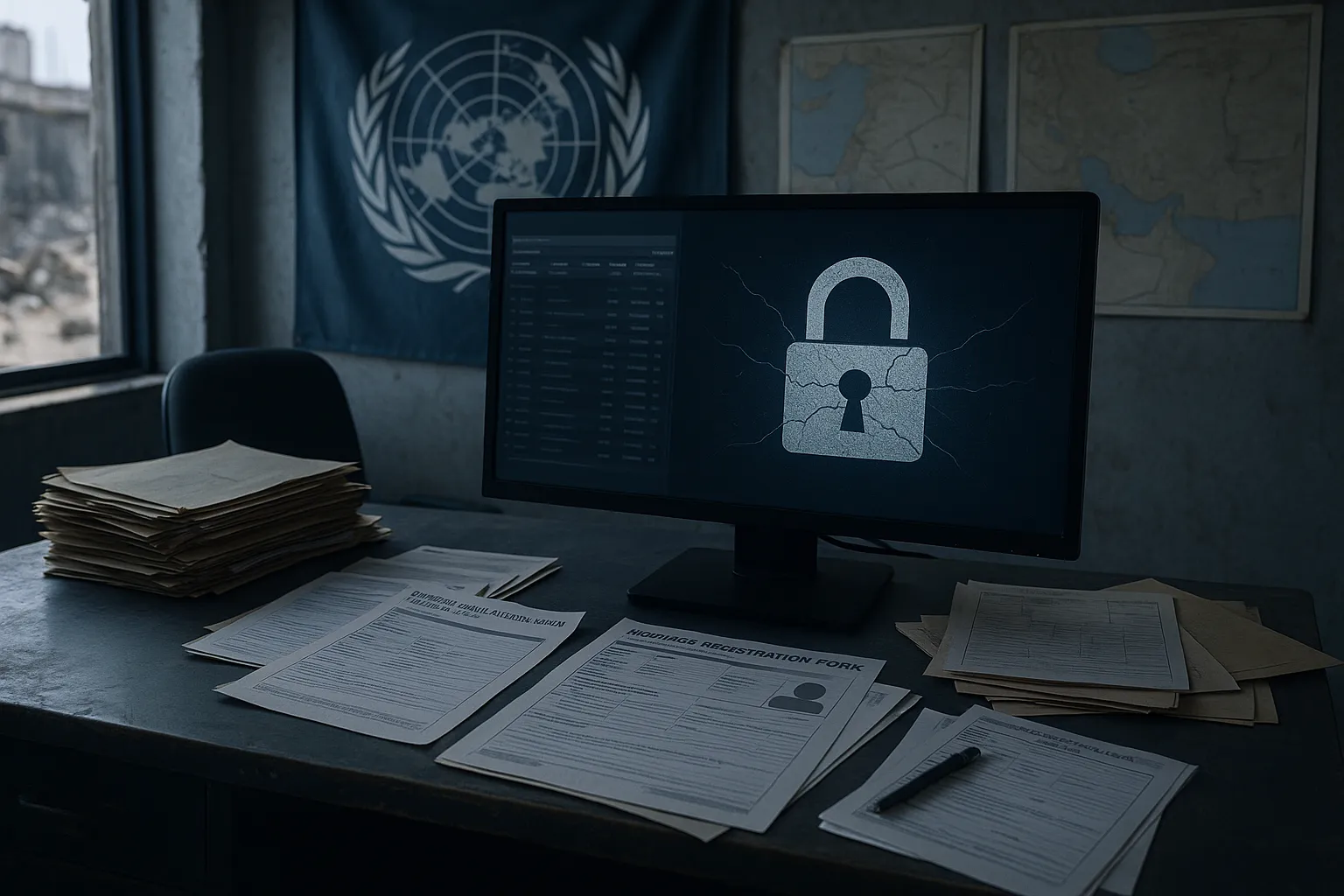
Attackers breached the UN World Food Programme's Gaza aid registration system on May 14, 2026, exposing names, ID numbers, phone numbers, health status, and displacement histories for approximately 600,000 Palestinian households — potentially millions of individuals — with the agency waiting more than two weeks before notifying recipients.
The United Nations World Food Programme is the world's largest humanitarian organization. It feeds over 150 million people annually. In Gaza, it operates a self-registration system that Palestinian households use to apply for food assistance — a system that, as of May 2026, contained the names, identity numbers, mobile numbers, family compositions, health statuses, and location data of roughly 600,000 households. On May 14, unauthorized actors breached that system and took all of it. WFP did not inform those households for more than two weeks. When notification finally came — via Telegram, not direct outreach to affected individuals — a whistleblower said the agency had conducted "no risk assessment" and made "no clear effort to evaluate or mitigate the security risks to people in Gaza."
Key Takeaways
- Attackers breached the WFP's Gaza self-registration application on May 14, 2026, stealing data belonging to approximately 600,000 Palestinian households — likely representing several million individuals.
- The stolen data includes names, ID numbers, mobile phone numbers, dates of birth, marital status, family member names and IDs, health status, current place of residence, and displacement history since October 7, 2023.
- WFP notified aid recipients on May 31, 2026 — seventeen days after the breach — via a Telegram message, despite the high-risk environment in which affected individuals live.
- Access Now, the digital rights organization, condemned the breach as potentially life-threatening, noting that the stolen location and identity data could be used to target aid recipients in an active conflict zone.
- This may be the largest breach of humanitarian beneficiary data ever recorded, surpassing the 2022 ICRC breach which affected approximately 515,000 records.
What Data Was Exposed?
WFP's Gaza self-registration system collects detailed household information from Palestinians applying for food assistance. The dataset exposed in the breach includes, for each household member:
- Full name and date of birth
- National ID number
- Mobile phone number
- Marital status
- Health status and any medical conditions flagged during registration
- Current place of residence or displacement location
- Number of times displaced since October 7, 2023, and displacement history
- Names and ID numbers of all family members in the household
The 600,000 households figure likely understates the total number of individuals affected. Because WFP requires registration for each household member, a single household registration representing a family of five means five people's names and ID numbers in the dataset. Palestinian household sizes in Gaza average higher than in many other contexts due to displacement and multigenerational living, meaning the individual-level exposure could reach several million people.
Why the Notification Delay Matters
WFP detected the breach within a day or two of the May 14 attack. The agency did not notify affected households until May 31 — seventeen days after discovery — and only via a Telegram announcement rather than direct outreach to affected individuals. In the context of an active conflict zone, seventeen days is not an administrative lag. It is time during which location data and identity information about hundreds of thousands of civilians was potentially in the hands of unknown actors, and during which those civilians had no ability to take protective action because they did not know they were at risk.
A WFP whistleblower told The New Humanitarian that, as of the May 31 notification date, the agency had conducted "no risk assessment" of the breach's impact and had made "no clear effort to evaluate or mitigate the security risks to people in Gaza." This is not a technical failure alone. It is a failure of humanitarian data governance — an organization whose entire purpose is to protect vulnerable populations making the decision to hold back breach information rather than give those populations the ability to make informed decisions about their own safety.
The Stakes of Humanitarian Data in a Conflict Zone
In peacetime, a data breach exposing names, phone numbers, and home addresses is a serious privacy incident that typically warrants credit monitoring and regulatory reporting. In an active conflict zone, the same dataset is potentially a targeting list. Access Now, in a statement condemning the breach, specifically noted that location data, displacement histories, and identity information about Palestinians in Gaza "could be used to surveil, target, or harm the very people WFP is trying to help."
This is the defining characteristic of humanitarian data breaches: the population most likely to be harmed is also the population least able to take protective action. A person displaced multiple times in an active war zone, relying on WFP food assistance to survive, has no meaningful ability to change their ID number, relocate on short notice in response to a data breach notification, or obtain the kind of legal remedies that breach notification laws envision. The information that protects their access to food is the same information that, in the wrong hands, identifies them.
For journalists and human rights researchers documenting this breach and similar incidents, the ICRC's 2022 breach of 515,000 records from the Restoring Family Links program provides a direct precedent. That breach also involved a third-party contractor, also affected conflict-affected populations, and also resulted in criticism of the humanitarian organization's breach response timeline. The WFP incident nearly doubles the record for the largest known humanitarian beneficiary data breach.
What Humanitarian Data Protection Should Look Like
The humanitarian sector has produced significant guidance on data protection in crisis settings. The ICRC's Handbook on Data Protection in Humanitarian Action, the Inter-Agency Standing Committee's guidelines, and the UN Secretary-General's Data Strategy all call for proportionate data collection, minimization of sensitive data retained in digital systems, and rapid breach response calibrated to the risk environment. The WFP Gaza incident represents a failure on all three dimensions: comprehensive data was collected and retained digitally in a high-risk environment, the breach response was delayed and communicated through a low-reach channel, and there is no public evidence of a pre-breach data minimization policy that would have reduced the damage.
The practical implications for advocacy organizations, journalists covering the conflict, and human rights researchers are concrete. Data held by humanitarian organizations about civilians in conflict zones should be treated as inherently high-risk — not because the organizations are hostile, but because the environments in which they operate are inherently hostile to data security. The principle of "do no harm" extends to data protection: collecting and retaining comprehensive displacement histories and health status data in a digital system is itself a form of risk that needs to be weighed against the operational benefits.
What Happens Next
WFP has not publicly identified the attacker or the technical method of the breach. The agency has not disclosed whether it has filed breach notifications with UN oversight bodies or national data protection authorities in countries where affected individuals hold citizenship or legal residence. Access Now has called for a full independent investigation, rapid harm mitigation measures for affected households, and a review of WFP's data collection and retention practices in conflict zones.
The broader question — whether UN agencies and humanitarian organizations should collect and retain this level of granular personal data in digital systems operating in active conflict zones, given the demonstrated vulnerability to breach — is unlikely to be resolved by this incident alone. But the gap between what WFP's data collection practices assumed about security and what the May 2026 breach demonstrated about reality is a data point that humanitarian data protection frameworks will need to account for.
Sources: The New Humanitarian: 600,000 Gaza Households Exposed in WFP Attack | Access Now: WFP Must Protect Palestinians After Massive Data Breach | The Record: UN Food Agency Investigates Gaza Aid Breach | BleepingComputer: WFP Breach Affects 600,000 Gaza Households.