Jun 19, 2026 · 6 min read
UK's Social Media Ban for Under-16s Builds a Surveillance System
Britain's law banning under-16s from social media will require every UK resident to verify their age to access major platforms — creating a national identity checkpoint that critics say trades one privacy risk for a larger one.
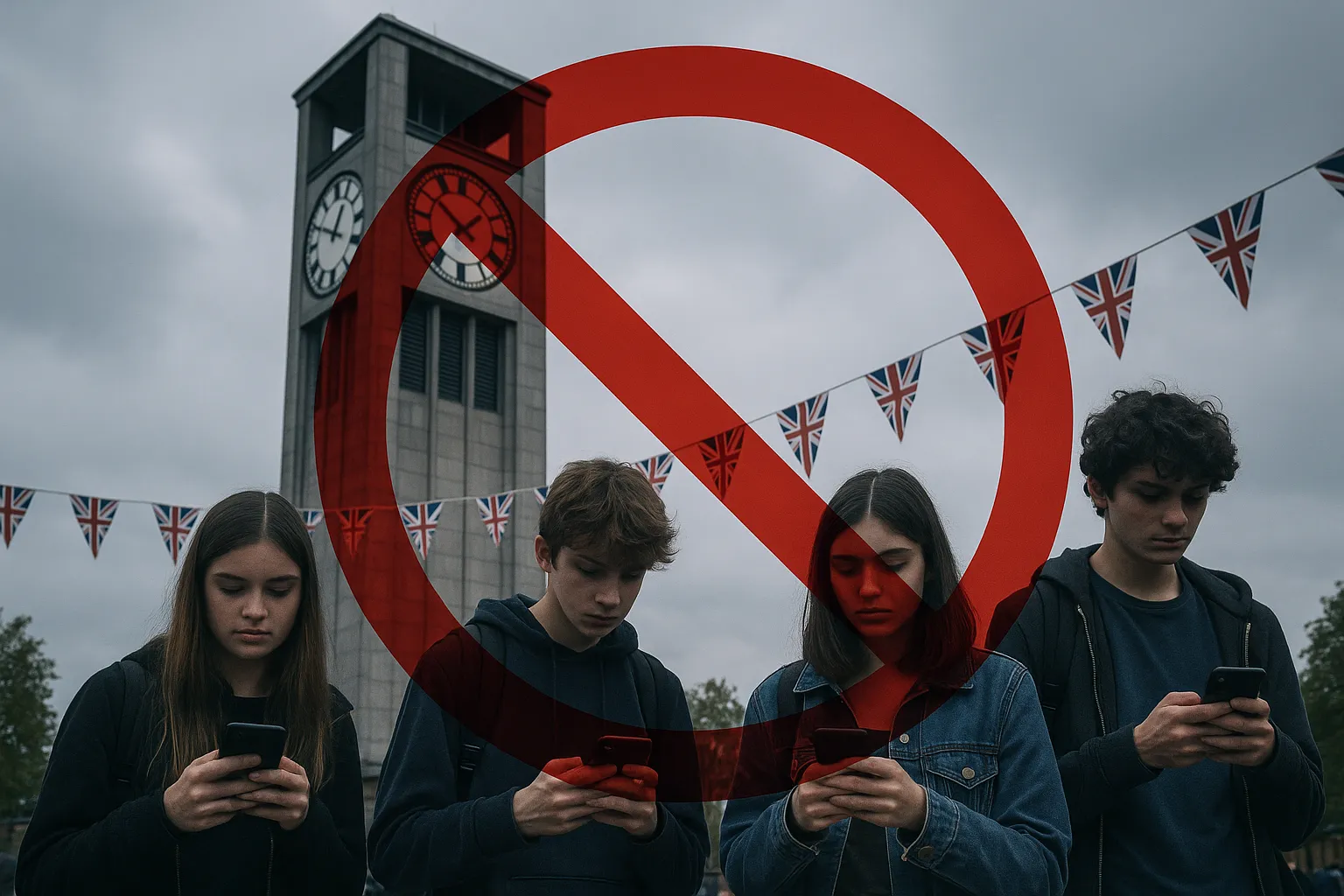
The UK's Social Media (Minimum Age) Act received royal assent in June 2026, mandating that platforms ban users under 16 or face fines of up to 10% of global annual revenue. The stated goal is protecting children from algorithmic harm. The unspoken consequence is that every adult in Britain must now prove their age to access Instagram, TikTok, X, and YouTube — and the methods being considered to verify that age look less like a child protection measure and more like the infrastructure of a national surveillance register.
Key Takeaways
- The Social Media (Minimum Age) Act, receiving royal assent in June 2026, bans under-16s from UK social media platforms and mandates age verification for all users.
- Platforms face fines of up to 10% of global annual revenue for non-compliance, creating overwhelming financial pressure to implement surveillance-grade age checks.
- Age verification systems proposed by Ofcom include government ID matching and facial age estimation — methods that require linking real identity to browsing behavior at scale.
- Digital rights groups including Big Brother Watch and the Open Rights Group argue the cure is worse than the disease: a surveillance apparatus targeting every UK internet user in the name of child safety.
- Australia, Canada, and multiple US states have passed or proposed similar legislation, making the UK law a template that could reshape online identity globally.
What Does the Law Actually Require?
The Social Media (Minimum Age) Act places the compliance burden on platforms, not on users. Social media companies must implement "robust age verification" to ensure no one under 16 can create or access an account. Ofcom, the UK's communications regulator, has been tasked with defining what "robust" means in practice and has published guidance pointing toward two technically feasible methods:
- Document-based verification: Users submit a government-issued ID — passport, driving licence — which is checked against official databases or third party verification services. This directly links a legal identity to a social media account.
- Facial age estimation: AI models analyze a selfie or video and estimate the user's age. This method does not require a name, but it does require collecting and processing biometric data from every adult who wants to post a tweet or watch a YouTube video.
Credit card verification — a softer proxy that platforms like Pornhub already use — is considered insufficient under the Act. The law requires something closer to identity confirmation, not just a payment method that implies adulthood.
Why Critics Call It a Surveillance System
The mechanism for verification creates a structural problem that child safety advocates have largely declined to engage with: any system capable of reliably identifying minors must first build a database linking real identities to online activity. That database does not need to be held by the government to function as state-adjacent surveillance infrastructure — it needs only to be accessible to the government when demanded, which under UK law it would be.
Big Brother Watch, a UK civil liberties organization, has argued since the Act's consultation phase that age verification will create "a comprehensive log of every adult's online activity — browsable by whoever holds the keys." The Open Rights Group has raised similar concerns, noting that third party age verification companies — which will inevitably handle much of this infrastructure — operate outside the direct accountability of either the platforms or Ofcom.
The UK already operates one of the most extensive CCTV networks per capita in the world. Its Investigatory Powers Act permits bulk interception of communications data. The age verification mandate extends that logic into a domain — social media account creation — that has until now been effectively anonymous for adults in Britain.
The Precedent Problem
Legislation banning minors from social media has now passed or advanced significantly in at least seven jurisdictions: the UK, Australia, Canada (Bill C-63), Florida, Tennessee, Texas, and Arkansas. Most of these laws use the UK and Australian frameworks as models. The practical effect is that legal templates requiring identity-linked age verification are spreading simultaneously across English-speaking democracies, each with slightly different technical requirements but all converging on the same outcome: real-name registration for social media use, backed by government-issued ID.
For journalists, activists, and dissidents, the implications are direct. Source protection depends on the ability to communicate with potential whistleblowers through channels that do not require registration. A social media ecosystem where every account traces back to a passport number is one where the surveillance risks for press freedom become structural rather than incidental. Reporters Without Borders has flagged age verification mandates in its methodology for the 2026 World Press Freedom Index, noting the chilling effect on anonymous source communications.
What About Privacy-Preserving Alternatives?
Zero-knowledge proofs offer a technical path that could satisfy the law's stated intent without building a surveillance apparatus. Under a ZK-based system, a trusted authority (a bank, a government digital identity scheme, or a telecom) could attest that a user is over 16 without revealing which user, which account, or any personally identifying information. The platform receives a cryptographic proof; no central database links identity to account.
Ofcom has acknowledged ZK proofs in its technical guidance but has not mandated them, leaving platforms to choose their verification architecture. Commercial incentives push platforms toward document-based systems, which are cheaper to deploy at scale and produce richer identity datasets as a byproduct. The privacy-preserving path requires more engineering investment and produces less data for the verifying party — making it unlikely to be chosen voluntarily.
The result is that the UK law's child safety goal — which has genuine public support — is being used to launder the construction of an identity verification layer that benefits governments and platforms far more than it benefits children. Teenagers determined to access social media will use VPNs, borrow adult accounts, or migrate to unregulated platforms. Adults who comply will hand their biometrics or government ID to third party verification companies whose data security and retention practices are opaque.
The Broader Pattern: Safety as a Vector for Surveillance
The Social Media (Minimum Age) Act fits a recognizable pattern in surveillance legislation: a genuinely concerning harm (algorithmic targeting of minors) is used to justify a technical intervention (age verification) whose architectural requirements produce surveillance infrastructure as a side effect. The harm is real. The intervention may reduce it at the margins. The side effect is structural and permanent.
Email surveillance follows the same logic. Email monitoring programs justified under national security frameworks tend to expand beyond their original mandates once the infrastructure exists. Age verification databases, once built, become targets for data brokers, foreign intelligence services, and governments with less restrained legal systems than the UK's.
What's being constructed in Britain is not just a content moderation policy. It is the technical foundation for real-name internet registration — built in the name of protecting children, deployed against everyone.