Apr 28, 2026 · 6 min read
The Supreme Court Is Deciding Whether Police Can Demand Google Hand Over Every Phone's Location Near a Crime Scene
Chatrie v. United States could define the Fourth Amendment limits on geofence warrants. The justices heard oral arguments on April 27.
The Case
In 2019, a credit union in Midlothian, Virginia was robbed at gunpoint. Investigators obtained a geofence warrant directing Google to hand over the location history of every device that was near the credit union during the robbery. That search identified Okello Chatrie's phone. He was arrested, convicted, and sentenced to 12 years in federal prison.
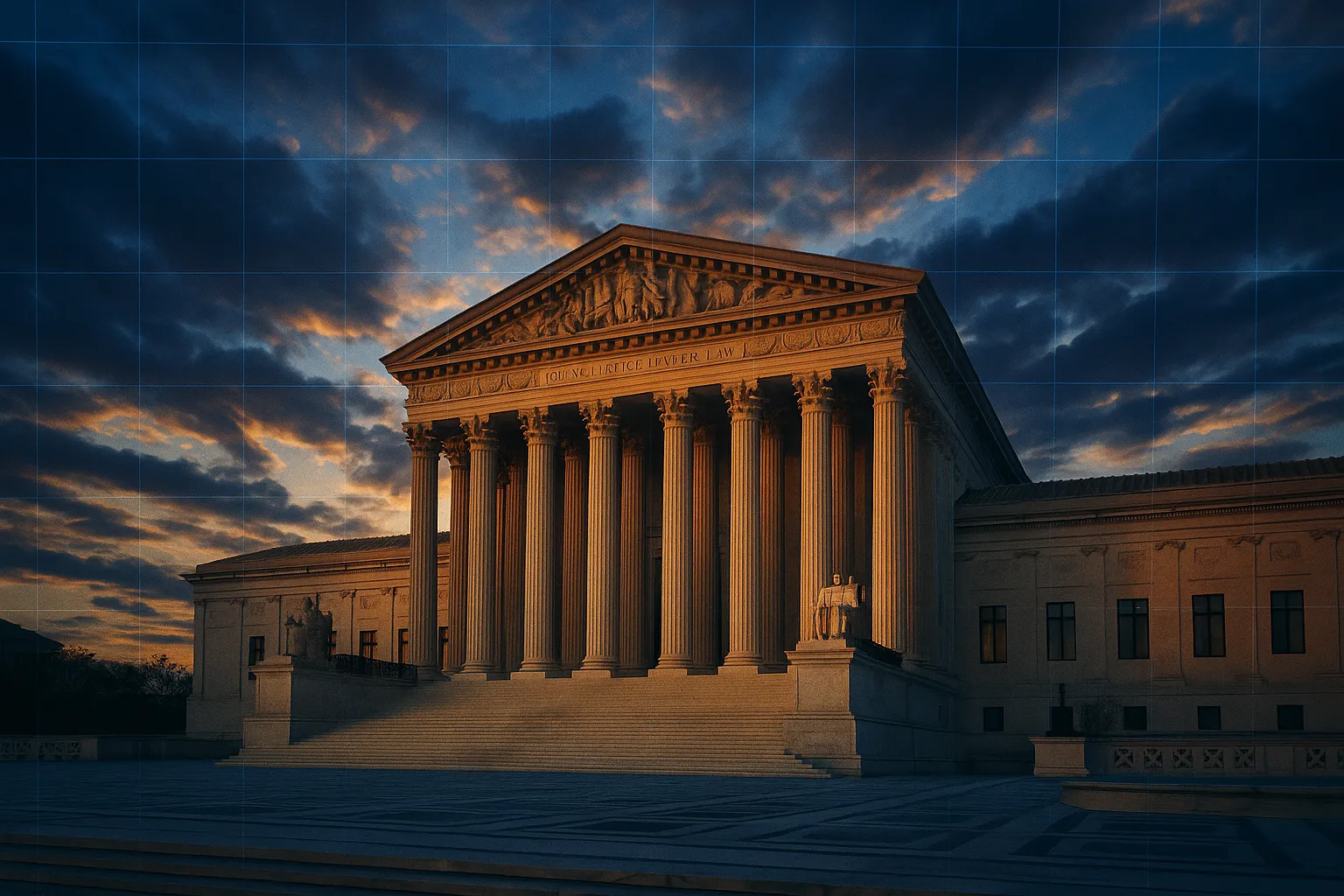
Chatrie argued that the geofence warrant violated his Fourth Amendment rights. On Monday, April 27, 2026, the Supreme Court heard oral arguments in Chatrie v. United States, a case that will define whether police can compel tech companies to search hundreds of millions of users' location histories to find suspects near crime scenes.
What Is a Geofence Warrant
A geofence warrant is a court order that tells a tech company to identify every device present in a defined geographic area during a specific time window. Unlike a traditional warrant, which names a specific suspect and asks for their data, a geofence warrant starts with a location and works backward to identify who was there.
In practice, this means Google receives a request that says: tell us which of your users were within this boundary, during this time period. Google then searches its Sensorvault database, which contains location records for hundreds of millions of users, and returns a list of anonymized device identifiers. Police narrow the list and then ask Google to unmask specific users.
The problem is scope. In its brief to the Supreme Court, Google highlighted that one geofence warrant covered 2.5 square miles of San Francisco for over 48 hours, potentially exposing thousands of users' location histories. Another covered 489 acres encompassing a mosque, homes, apartments, and a university campus. Everyone who walked through those areas with a phone became a potential suspect, regardless of whether they had any connection to the crime being investigated.
What the Justices Signaled
During oral arguments, a majority of justices indicated they are likely to rule that geofence searches constitute a Fourth Amendment search requiring a warrant. However, the court appeared reluctant to ban them outright. Several justices signaled interest in a compromise: requiring judicial warrants while allowing law enforcement to continue using the technique within constitutional limits.
The justices questioned both sides sharply. They pressed the government on whether the broad scope of geofence warrants could meet the Fourth Amendment's "particularity" requirement, which demands that warrants specify the place to be searched and the persons or things to be seized. They also pressed Chatrie's lawyers on whether banning geofence warrants entirely would deprive law enforcement of a legitimate investigative tool.
A ruling is expected by the end of the current Supreme Court term, likely in June or early July 2026.
Why This Matters Beyond Crime Scenes
Geofence warrants have been used in contexts far beyond violent crime. Journalists, researchers, and civil liberties organizations have documented cases where geofence warrants were served for areas around political protests, houses of worship, and reproductive health clinics. If the court rules that these searches are constitutionally permissible with minimal constraints, it would create a legal framework for mass location surveillance tied to any geographic area at any time.
The implications for journalists and activists are particularly serious. A geofence warrant served on the area around a confidential meeting between a reporter and a source could identify both parties. A warrant covering a protest location could generate a list of every attendee. Even if a person is never charged with a crime, their location data has been collected, stored, and reviewed by law enforcement.
Google's Shifting Position
Google filed an amicus brief in support of Chatrie's position, arguing that the geofence warrant in this case was overly broad. The company highlighted the scale of its Sensorvault database and the invasive scope of the searches it receives. However, Google's position has evolved over time. The company processed thousands of geofence requests annually before announcing in December 2023 that it would begin storing location data on users' devices rather than centrally, making future geofence warrants technically infeasible for new data.
That change does not help Chatrie or the millions of users whose historical location data remains in Google's systems. It also does not prevent other companies from building similar centralized location databases. If the court upholds geofence warrants as constitutional, law enforcement could shift its requests to any company that holds location data: wireless carriers, app developers, or advertising networks that track users through their phones.
The Broader Surveillance Landscape
Chatrie v. United States arrives at a moment when location surveillance is expanding across multiple fronts. Advertising networks already let police track 500 million phones without a warrant by purchasing location data from ad exchanges. The UK government has acknowledged that 100 countries now have spyware capable of hacking individual phones. And the debate over Section 702 surveillance authority continues in Congress, with 349,823 surveillance targets documented in 2025 alone.
The Supreme Court's decision in Chatrie will determine whether the Fourth Amendment provides a meaningful check on one of the most powerful surveillance tools in modern law enforcement's arsenal, or whether the Constitution's protections stop at the door of a tech company's data center.
What You Can Do Now
Regardless of how the court rules, users can reduce their exposure to geofence surveillance:
- Disable Location History in your Google account settings. Google's Sensorvault only collects data when this feature is enabled.
- Review app permissions. Many apps request location access they do not need. Revoke permissions for any app that does not require your location to function.
- Use a privacy focused browser that does not share location data with advertising networks.
- Turn off WiFi and Bluetooth scanning when not in use. Both can be used to approximate your location even when GPS is disabled.
The Supreme Court will decide whether police need a warrant to search your location history. Until that ruling arrives, the simplest defense is to stop generating the data in the first place.