Nov 05, 2026 · 6 min read
Mamdani Criticizes MSG Surveillance, Backs Face Scan Ban
No letter, no liquor license threat. The mayor did something slower: he put City Hall behind a Council bill that would make facial recognition at venues like the Garden illegal.
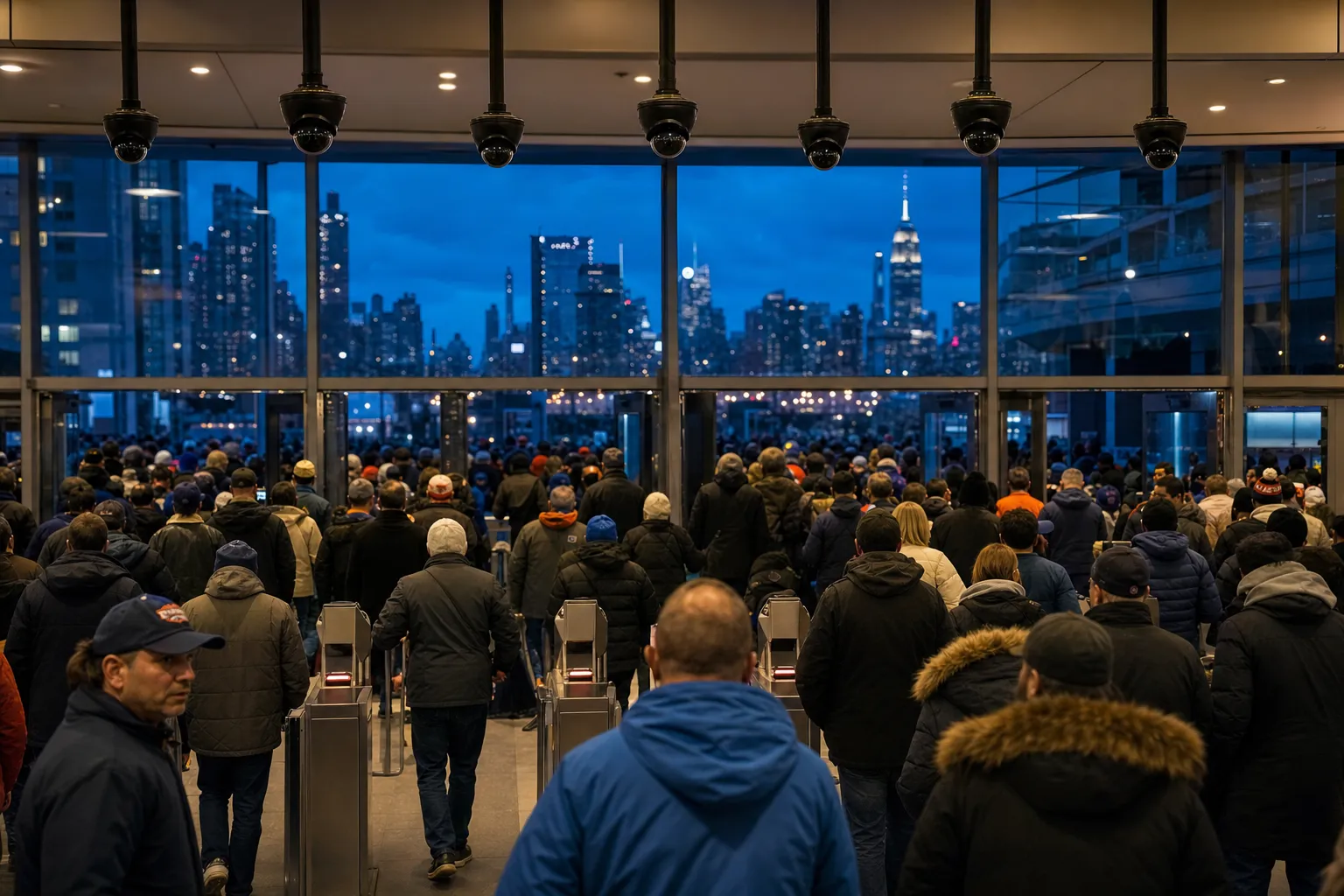
Every fan who walks through the turnstiles at Madison Square Garden has their face checked against a list. James Dolan's company has used that system to turn away lawyers and critics. According to Wired, it also labels visitors in an internal database. On November 3, 2026, Mayor Zohran Mamdani said this kind of surveillance should not be allowed, and named the bill he wants to stop it.
Key Takeaways
- Mayor Zohran Mamdani told Wired on November 3, 2026 that surveillance technologies like those at Madison Square Garden are "indicative of much that is wrong in our country today."
- Intro 213, sponsored by Council Member Shahana Hanif, would bar places of public accommodation from using biometric recognition technology to identify or verify customers, and has 28 Council sponsors, a majority.
- MSG spokesperson Mikyl Cordova called Wired's reporting "inaccurate and false" and said MSG is pursuing legal remedies, without offering evidence.
- New York City's current biometric law, in force since July 2021, only requires a sign at the entrance and bans selling the data; it does not require consent or offer an opt out.
What Did Mamdani Say About MSG?
Mamdani criticized the surveillance system run by MSG owner James Dolan in an interview with Wired, and endorsed Council legislation to ban it. As TechCrunch reported, he said surveillance technologies are "indicative of much that is wrong in our country today," and called Hanif's draft legislation "an important response to this kind of an issue."
It was an endorsement, not an executive action, and it repeats one his administration already made: in August, Consumer and Worker Protection Commissioner Sam Levine backed the bill, saying "this kind of mass surveillance opens the door to abuse and discrimination," NBC New York reported.
MSG spokesperson Mikyl Cordova told TechCrunch: "Wired's reporting is inaccurate and false. MSG is pursuing legal remedies." Dolan has already sued Wired.
What Is MSG Accused of Doing With Facial Recognition?
MSG uses facial recognition at the Garden, Radio City Music Hall and the Beacon Theatre to enforce bans on specific people, starting with lawyers whose firms are suing the company. The policy surfaced in 2022, when a Girl Scout mother was pulled out of a Rockettes show, as Hell Gate recapped. In January 2023, Attorney General Letitia James wrote to MSG Entertainment that the policy reportedly affected "more than 90 law firms" and might violate civil rights law.
Wired's 2026 reporting went further. In July, it reported on an internal database that, per Gothamist, cataloged "nearly 40,000 entries" on prominent figures; MSG calls it a customer relations tool. More than 90 entries carried the label "LGBTQIA," according to Mediaite's summary.
The data has also leaked. In June, ShinyHunters dumped 45GB of MSG files, including facial recognition records and celebrity risk ratings. That came months after Cl0p stole Social Security numbers of 131,000 people through MSG's Oracle E-Business Suite vendor.
What Would Intro 213 Actually Change?
Intro 213 would make face scanning of customers illegal in places of public accommodation, a category that runs from arenas to corner shops. The Council's bill summary says it would ban using biometric recognition "to verify or identify a customer," require notice whenever biometric data is collected, require written consent before any such technology is used, and require collected data to be protected under published policies.
Today, Local Law 3 of 2021 (Administrative Code 22-1201 to 22-1205) asks entertainment venues, retailers and food businesses that collect biometric data for exactly two things:
- A "clear and conspicuous sign" near all customer entrances.
- No selling, leasing or otherwise profiting from the data.
There is no consent requirement and no opt out. A missing sign costs $500 per violation, and the business gets 30 days to cure after written notice. Selling the data intentionally costs $5,000. MSG says it posts the required signs, so the city biometric law has never reached the lawyer ban at all.
A second bill, Intro 428, would bar residential landlords from using biometric recognition on tenants and their guests.
Why Haven't Regulators Stopped MSG Already?
Every enforcement route tried so far has left the cameras running. The AG's 2023 letter asked questions; it did not force a shutdown. The State Liquor Authority spent four years arguing MSG's lawyer ban violated its public access rules for licensees. In July 2026 the access charges were dropped, and MSG, Radio City and the Beacon each paid $10,000 for an unrelated "unauthorized corporate-change charge," Gothamist reported.
That $30,000 total is the only regulatory penalty we could find connected to the lawyer ban, and it was technically for paperwork. Most coverage reads Mamdani's comments as a political jab at Dolan. The bigger point is that the sign law, the liquor license and the AG letter were all built to police disclosure or access, not the scan itself. A ban is the first lever aimed at the camera.
What This Means for Your Face (and Your Inbox)
A password can be changed after a breach. A face template cannot. That is why Intro 213's data protection clause matters as much as the ban itself. Illinois learned this years ago; its biometric privacy law is still driving suits like the Whoop and Oura class actions.
The leak also reaches inboxes. The ShinyHunters dump included customer emails complaining about facial recognition misidentification. If you ever emailed MSG about the cameras, assume a scammer knows your name and the venue. Treat any email about the MSG class action with suspicion, and type claims site addresses yourself.
What Can NYC Residents and Visitors Do Now?
Until Intro 213 passes, your options are limited:
- Look for the sign. Any covered business that collects biometric data must post one near every customer entrance. DCWP publishes the official disclosure sign.
- If there is no sign, send written notice. Under Admin Code 22-1203 you must notify the business in writing and give it 30 days to fix the problem before suing for $500 per violation.
- Know that there is no opt out. City law gives you no right to refuse a scan and still enter, and no right to a copy of your biometric data. Ask in writing anyway.
- Tell your Council member and the Speaker where you stand. Intro 213 has majority support, per ID Tech. It lacks a vote, which Speaker Menin controls.
- Report being turned away. If a face match gets you barred, complain to the Attorney General's office, which has already flagged possible civil rights violations.
What Happens Next?
Intro 213 sits in the Committee on Technology, laid over after its March 2, 2026 hearing, with 28 Council sponsors plus the Public Advocate. Mamdani cannot sign it until the Council passes it, and that depends on Speaker Menin calling a vote. MSG's suit against Wired will separately test its "customer relations" defense in court. The mayor's endorsement changes the politics, not the calendar: more than nine months after introduction, the bill still has not had a committee vote.