Jun 16, 2026 · 7 min read
California's AB 2564 Would Be the Strictest Surveillance Pricing Ban in the Country
Surveillance pricing — the practice of using your browsing history, location data, and demographic profile to charge you more than someone else for the same product — is already illegal in Maryland and Connecticut. California's AB 2564, which passed the Assembly on May 27, 2026, would apply a stricter version of the ban to the country's largest consumer market.
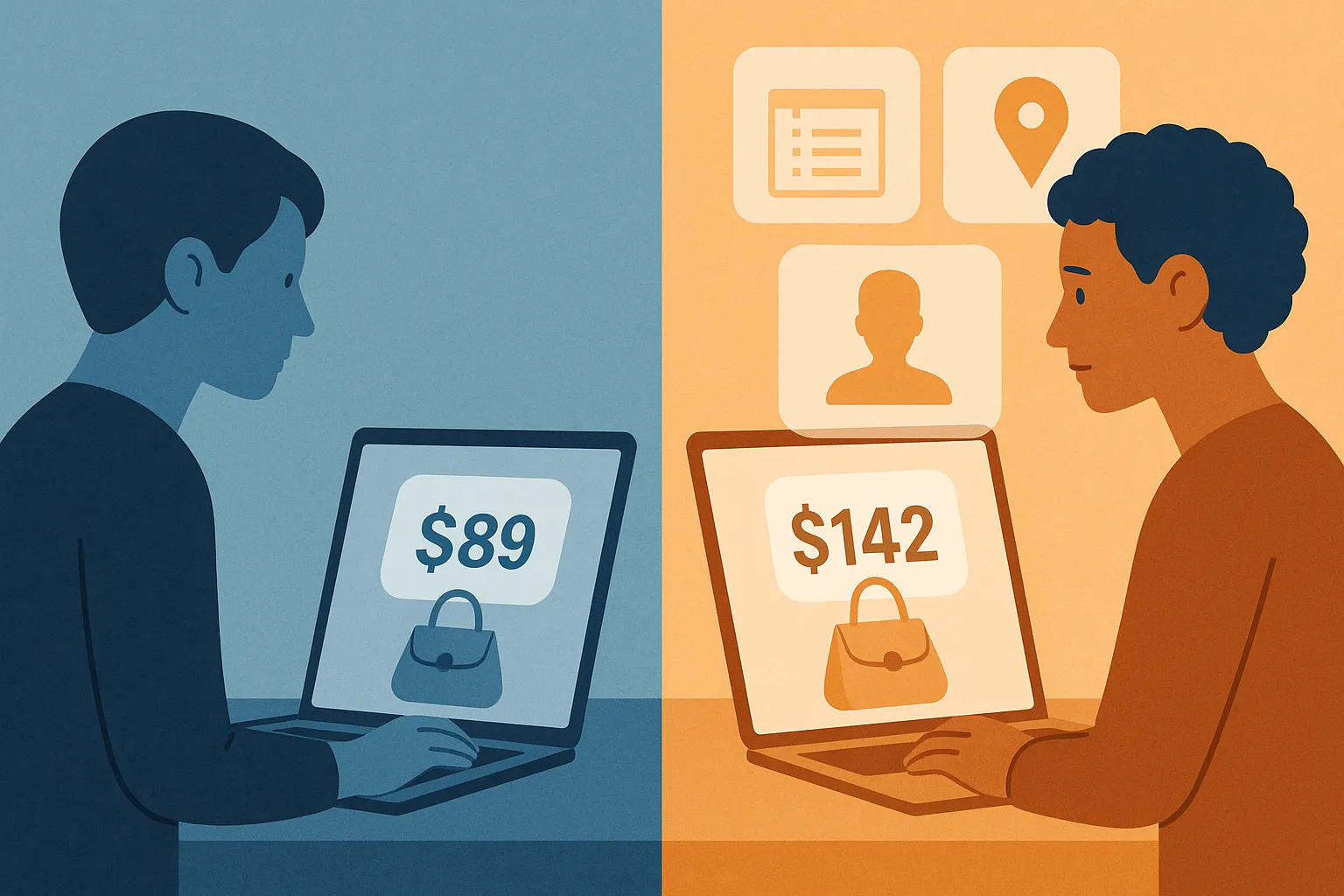
When you open a retailer's email, click a link, or browse a product page, you generate data. That data gets collected. Sometimes it gets used to show you ads. Increasingly, it also gets used to determine what price you see when you add something to your cart. Surveillance pricing is the practice of offering the same product to two different people at two different prices, based on what the retailer's algorithm has inferred about each person's willingness to pay.
It is not the same as a sale. It is not a loyalty program discount. It is a retailer looking at your browsing history, your IP address, your physical location, and your demographic profile — and deciding you will probably pay more. Then charging you more. California's AB 2564, introduced by Assemblymember Chris Ward on February 20, 2026, would make that illegal for any retailer operating in the state.
Key Takeaways
- California Assembly Bill 2564 passed the Assembly on May 27, 2026, by a substantial margin, and now awaits Senate consideration.
- The bill defines surveillance pricing as setting a customized price for a consumer based on personally identifiable information collected through electronic surveillance technology, including browsing history, geolocation, income, and demographic data.
- The Federal Trade Commission found in a 2024 study that retailers use this data to predict "whether a shopper is desperate to buy or how much money they have" and price accordingly.
- Documented examples include Instacart charging customers different prices in the same store at the same time, Princeton Review setting prices that made Asian Americans twice as likely to receive a higher offer, and Orbitz showing Apple users more expensive hotels.
- Unlike Maryland's surveillance pricing ban — the first in the country, enacted in May 2026 — California's bill contains no grocery store carve-out and no loyalty program exception for data-based personalization.
- Enforcement is dual-track: government agencies can seek monetary penalties, and individual consumers can sue for injunctions and attorney fees.
What Surveillance Pricing Actually Looks Like
The practice sounds abstract until you see the documented cases. In December 2025, an investigation found that Instacart charged hundreds of customers different prices for groceries in the same store at the same time — including at least 53 California residents. The variable: personal data associated with each account, used to estimate what each individual would pay.
The Princeton Review was found to have charged customers different prices based on zip code in a pattern where Asian Americans were twice as likely as non-Asian Americans to receive a higher price offer. Orbitz showed Apple computer users more expensive hotel options than Windows users. Tinder charged users aged 30–49 substantially more than users aged 18–29 for the same subscription. Target paid $5 million settling a lawsuit over location-based pricing practices.
These are documented cases — the ones that became lawsuits or investigations. A Federal Trade Commission report examining the broader market found that the practice draws on browsing history, physical location, and shopping transaction history, and that the underlying algorithms can predict whether a shopper is in urgent need of an item or has financial capacity to absorb a higher price. The same report found that surveillance pricing is now common enough that roughly half of U.S. states are considering regulatory responses.
The Email Tracking Connection
Surveillance pricing algorithms don't generate their own data. They consume data generated elsewhere — and one of the richest inputs is email engagement. When a retailer sends you a promotional email with a tracking pixel embedded, and you open that email, the sender records the time, your IP address (often sufficient to determine city and ISP), and the fact that you engaged. When you click a link in that email, they record which product you looked at and for how long.
That behavioral signal — "this person opened our email three times before buying" or "this person clicked the product but didn't purchase at $89" — is exactly the kind of input that calibrates a pricing algorithm. A customer who repeatedly opens emails about a product but hasn't purchased may be shown a lower price to convert them. A customer who purchases at full price consistently may be shown a higher baseline. The email pixel is the data collection instrument. The pricing algorithm is where the discrimination happens.
AB 2564's definition of prohibited inputs includes "browsing history" and "shopping patterns and engagement history." Whether click data from a retailer's own promotional emails counts as browsing history under the bill's language is a question that will likely be resolved in regulatory guidance or litigation. But the connection between email tracking and retail data pipelines is direct: the pixels that follow your inbox engagement are part of the same data economy that surveillance pricing draws from.
How AB 2564 Compares to Maryland and Connecticut
Maryland became the first state to ban surveillance pricing when it enacted HB 895 in May 2026 — but the Maryland law applies only to grocery stores and contains carve-outs for loyalty programs that effectively preserve data-driven discounting under a different legal framing. Connecticut's SB4, which passed in May 2026, banned surveillance pricing as part of a broader data broker regulation bill, but with enforcement concentrated at the attorney general level.
California's AB 2564 takes a broader approach on two dimensions. First, it applies to retailers generally — not just grocery stores — covering online marketplaces, physical storefronts, and e-commerce platforms. Second, it includes a private right of action: individual consumers can sue retailers directly, seeking injunctions and attorney fees. The Electronic Frontier Foundation's analysis notes that EFF would prefer the bill also include liquidated damages — a per-violation dollar amount — to give the private right of action more financial teeth. But the current version is still the broadest surveillance pricing restriction any U.S. state has enacted.
The California law also contains three narrow exceptions: price differences based solely on delivery costs, discounts for service termination, and uniformly available discounts that anyone can access by meeting publicly advertised criteria. Loyalty program discounts would remain legal only if they are not personalized based on individual data profiles — a meaningful distinction from Maryland's approach, which exempts loyalty programs more broadly.
The Opposition Case
The California Chamber of Commerce has labeled AB 2564 a job killer. Business groups representing retailers and technology companies submitted opposition letters arguing the bill is overly broad, difficult to comply with, and would prevent stores from offering targeted discounts — which they characterize as consumer benefits rather than surveillance instruments.
The substantive compliance concern is real: the bill would require retailers to restructure how they use customer data for pricing decisions, and for large e-commerce operations with hundreds of millions of data points, determining which inputs violate the law's prohibition on "electronic surveillance technology" data would require significant legal and engineering work. The Chamber's argument that the bill "drives up costs" rests on the assumption that surveillance pricing primarily benefits consumers — a claim that the Instacart, Princeton Review, and Target cases directly contradict.
The political alignment is notable. Consumer Reports, the Consumer Federation of America, EPIC, and labor organizations support the bill. The opposition comes entirely from industry groups. That alignment tracks the national pattern: surveillance pricing is one area where consumer advocacy and privacy advocacy overlap almost completely, producing unusually broad support coalitions for legislation that would otherwise face partisan headwinds.
What Comes Next
AB 2564 now sits in the California Senate. If it passes the Senate and is signed by the governor, it would apply to all retailers operating in California — which effectively means any significant U.S. e-commerce operation, given California's size. A retailer that sells to California consumers could not maintain one pricing algorithm for California and a different one for other states without substantial systems separation; as a practical matter, California's consumer market tends to export regulatory standards nationally.
This is the same dynamic that made California's CCPA the de facto privacy baseline for U.S. companies in the years after its passage — a reality that the California attorney general's recent enforcement actions against companies like 23andMe over genetic data and retailers over CCPA violations underscore. If AB 2564 becomes law, the pricing data practices that currently affect hundreds of millions of Americans could face their most consequential legal challenge to date — in a state court system with a plaintiff's bar already primed for privacy litigation.
For consumers, the near-term step is limiting the data retailers can collect to feed these algorithms. That means blocking the email tracking pixels that report your engagement back to senders, using privacy-respecting browsers, and being selective about which loyalty programs you participate in. Legislation takes time. Data minimization is available now.
Sources: EFF: Yes to California's Bill to Ban Surveillance Pricing | CalMatters: Why surveillance pricing bans are suddenly gaining traction | Crowell & Moring: California's Sweeping AB 2564 | Consumer Reports: California Assembly passes AB 2564.